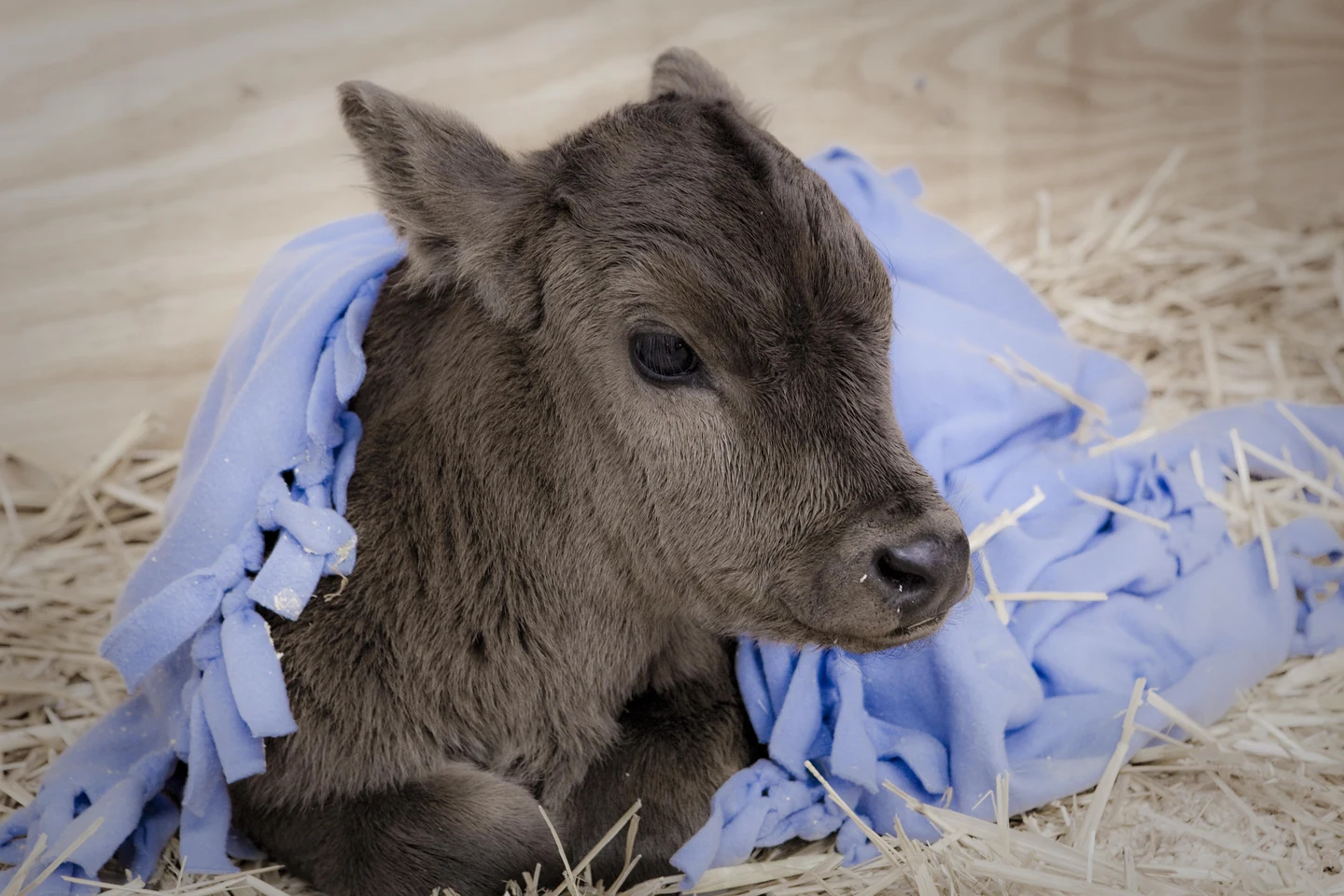
Every newborn baby needs warmth, safety, and a mother's gentle care. That is how life is meant to begin for every creature on this earth.
Yet on commercial dairy farms across the country, newborn calves are routinely separated from their mothers within their first 24 hours of life. We are asking Congress to require basic mother-and-calf bonding time so babies receive the nourishment and care they deserve.
Because a kinder world begins with how we care for its smallest, most defenseless lives.
What happens after birth?
A comprehensive review of 70 scientific studies found no consistent health evidence supporting early newborn separation. In reality, calves are born with zero maternal antibodies in their bloodstream. They rely entirely on their mother's colostrum (first milk) within the first 6 hours of life to build vital natural immunity against life-threatening infections. [1]
A mother's licking warms the newborn calf's body, clears fluid from their lungs, and stimulates healthy rumen development. Providing compassionate care means honoring this natural bond while ensuring clean bedding and proper veterinary nutrition.
Science proves the bond matters
In 2023, European scientific authorities (EFSA) confirmed that calves do best when they stay with their mothers. They recommend prolonged cow–calf contact after birth, adequate feeding, clean bedding, and early social housing. [2]
01 / UNDERSTAND THE PROTECTION GAP
How can this happen within the law?
Most people assume all animals have legal protection from mistreatment. But American laws have big gaps when it comes to farm animals.
FEDERAL · ANIMAL WELFARE ACT (7 U.S.C. § 2132(g))
Farm animals are completely excluded from federal protection.
Under 7 U.S.C. § 2132(g), the federal Animal Welfare Act specifically excludes livestock used for food or fiber. While pets and laboratory animals receive federal humane handling rules, dairy cows and their newborn calves have no federal law protecting them on the farm. [3]
In plain terms: Federal law does not require farmers to keep mothers and calves together, leaving newborn care unregulated.
FEDERAL · HUMANE METHODS OF SLAUGHTER ACT (7 U.S.C. § 1901)
Protection at slaughter is not protection during life.
This law only governs the final hours inside a slaughterhouse. It establishes zero standards for how a baby calf is housed, fed, or cared for during its upbringing on production farms. [4]
In plain terms: Slaughterhouse rules do nothing to protect a newborn calf during its life on the farm.
STATE LAWS · CALIFORNIA EXAMPLE (PROPOSITION 12)
Some states require pen space, but maternal contact is still not guaranteed.
California voters outlawed extreme veal confinement crates, requiring at least 43 square feet of floor space per calf. While this gives calves space to stand and turn around, no state law requires newborn calves to remain with their mothers. [5]
In plain terms: Space rules help, but bonding and neonatal care remain unprotected by law.
Why we need a nationwide federal standard
Because dairy products move across state borders, Congress has the legal power under the Interstate Commerce Clause to set nationwide neonatal dairy care standards. Our petition formally submits this request to the House Agriculture Committee.
02 / OUR FOUR-PILLAR CARE PLAN
From a moment of crisis to a lifetime of care.
Here is our practical 4-step pathway to rescue individual animals and protect millions more through law:
01
Immediate rescue & warm transport
We work with farms and rescue haulers to legally surrender vulnerable or unwanted calves. Every rescue begins with a climate-controlled trailer and a warm nursery bed ready before the animal arrives.
Priority: Safe emergency intake and thermal stabilization within hours.
02
24/7 Veterinary formula & medical care
Licensed veterinarians examine each newborn calf. We provide warm colostrum milk formula, IV electrolyte fluids for dehydration, antibiotic treatment for infections, and sterile umbilical care.
Priority: Individual medical triage and around-the-clock bottle feeding.
03
Open pasture sanctuary for life
Calves need companionship and room to run. Once weaned off milk bottles, our rescued calves move to open green pastures where they live out their full natural lives in peaceful family herds—never facing an auction ring again.
Priority: Lifelong safety, clean water, and green meadows.
04
Speaking up in Washington
Every calf we save gives us real evidence. We turn verified rescue records into testimony and deliver citizen petition signatures directly to the House Agriculture Committee to push for permanent legal reform.
Priority: Permanent nationwide protections for millions of calves.
COMPASSION BACKED BY VETERINARY SCIENCE
Caring for both mother & baby.
A 2024 veterinary study found that cows and calves form deep emotional bonds. Moving animals requires thoughtful veterinary oversight, gradual weaning, and clean housing. Our mission combines warm hearts with experienced medical care—giving every animal the best chance at a happy, healthy life. [6]
03 / HOW YOUR SUPPORT HELPS
A signature speaks. Care takes resources.
Your signature asks Congress to change the law for tomorrow. An optional gift feeds and heals vulnerable orphaned calves tonight.
Saving a life starts with transport, but keeping a calf healthy requires continuous care for months. Here is where frontline funds go:
Safe fencing, winter barn shelters, clean fresh water troughs, and lifelong pasture upkeep.
Why someone might give once
A one-time gift helps pay for an emergency rescue run, urgent medicine, or livestock auction release fees tonight.
Why someone might give monthly
Calves need 90 continuous days of warm milk formula bottles before they can digest pasture grass. A monthly gift ensures our caregivers can feed them every single day until they are fully weaned.
Your voice is enough to take part. Giving is always an optional choice, never the price of having your signature count.
04 / TRUST SHOULD BE EARNED
You deserve to know who is doing the work.
Our commitment to transparency and supporter trust:
Verified care operations: Direct hands-on rescue and certified pasture sanctuary facilities.
Medical documentation: Veterinary intake charts, health records, and documented animal recoveries.
Clear financial accountability: Donations go straight to daily formula feed, veterinary medicine, and nursery shelter.
Traceable advocacy: Verified citizen signatures delivered directly to federal lawmakers and committees.
THE OFFICIAL PETITIONDOCKET #AGR-2026-884
Give them a kinder beginning.
To the Members of the United States Congress and the House Committee on Agriculture:
We, the undersigned citizens, respectfully ask you to enact federal neonatal care standards for dairy livestock:
01
Protect the mother–calf bond
Establish mandatory standards requiring newborn calves to stay with their mothers for natural nursing and maternal grooming, with exceptions only for medical emergencies.
02
Mandate proper nutrition and shelter
Require continuous access to colostrum, high-quality formula, dry thermal bedding, and social grouping for all calves during their first 12 weeks of life.
03
Ensure transparent welfare oversight
Require commercial dairy facilities to keep animal welfare records open to independent veterinary inspection and public reporting.
No, never. Signing the petition is 100% free. Your name and constituent signature will be officially recorded in Congressional Docket #AGR-2026-884 whether or not you donate.
Where does my signature go?
Signatures from across the country are compiled and delivered to the U.S. House Committee on Agriculture and key Senate offices to demonstrate nationwide citizen support for humane farming legislation.
Where do donations go?
Donations fund direct animal care: buying daily warm milk formula and electrolytes for orphaned calves, paying veterinary medicine bills, and maintaining safe permanent pasture sanctuary.
Does federal law require calves to be separated?
No. The Animal Welfare Act exclusion does not order farmers to separate calves. The problem is a lack of statutory protection requiring maternal contact. Read the legal context.
Can I cancel a monthly gift?
Yes, at any time with a single click or email. Monthly gifts are completely voluntary and under your control.
READ THE EVIDENCE
The sources behind the story.
All scientific research and statutory citations are listed below for complete transparency: